
In a nutshell, my courses in this term are like this:
“1 practical course and 3 theoretical courses. Total: 14 credits”
How could you take 14 credits? Aren’t freshmen only able to take 19-20 credits?
Well, I changed my major from Electrical Engineering UI to Computer Science UI. That’s why I could transfer some of my credits which made me have fewer courses in the first term. This situation also caused me to be able to take courses in the following terms.
What is practical and theoretical course?
Practical course is a course that will be likely to be implemented in the industrial world. Studying it is as if learning how to use a tool. On the other hand, theoretical course is a course that will be likely to be used in the research world. Studying it is as if learning the very basic foundation of how a tool works which later on could be used to make a cutting-edge breakthrough.
NOTE: I’m sorry that I couldn’t review all the courses that should be taken in the first term like MPKT-B, MPK-English, and Basic Physics because I had transferred the credits and my memory is already fuzzy for those courses.
Let’s start this review with the practical one:
1. Programming Foundations 1 (4 credits)
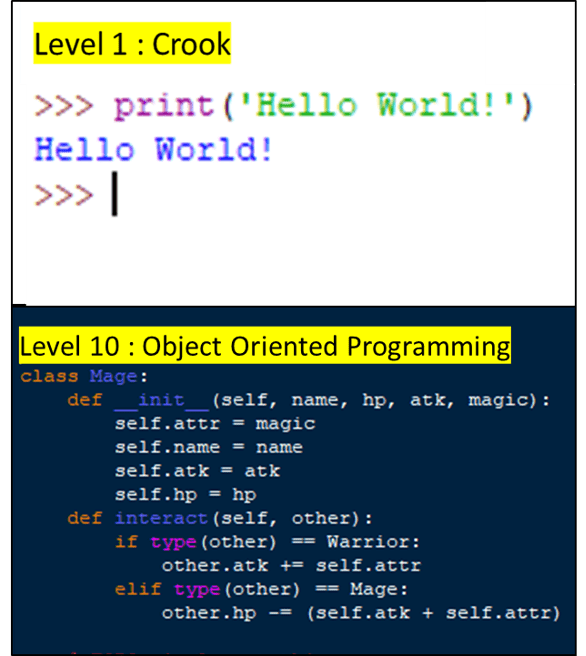
What did I study in this course?
In this course, I learned how to program with Python Programming Language. I learned the basics of data structures, how to control computer algorithms, solving problems with object-oriented programming, etc. Besides learning how to use python, I also learned how to use its libraries like Turtle (for drawing), Flask (for web development), and Matplotlib (for data visualization).

Why I categorize this course as practical?
Because after completing this course, the students are expected to adept at implementing python which could be the foundation for data science, machine learning, bioinformatics, and web development.

for employees that skilled in this language
How was this course system?
This course contained 4 credits which took 200 minutes for 2 classes and 100 minutes for a tutorial. Back then my Monday and Wednesday morning were used for classes and Monday afternoon was used for the tutorial. If I count it right, you will have 9 absence quotas for this course hehe (3 months x 4 weeks x 3 days x 25%). The scoring system was like this.

In the class, the lecturer taught us the basics and in the lab (for tutorial), we have to implement those basics to solve programming problems. If we stuck at the problem, the laboratory assistant (labsis) will give us a hint, so don’t be afraid to ask them. Now, the funny thing in the lab is that you can be a hero here. Sometimes, the problems are too hard and most of the students have no idea how to deal with it. This is your chance to flirt help others and if you can consistently do that, you will get the title “TOKILLER” which means your skill is like one of those Informatics Olympiad Medalists (unless you are an Informatics Olympiad Medalist itself of course). But if the problems were too hard to be solved in 100 minutes, the labsis would extend the lab duration or increase the score of the easier problem.

Big thanks to the laboratory assistant for making interesting problems
Besides the class and the lab, the most memorable thing about this course is programming task (PT). This programming task will make you sit all day long in front of computer/laptop to solve problems or to learn something new. I still remember that I spent a day learning how to use HTML and CSS to make the front-end and two days learning how to use Flask and WTForms to make the back-end (PT 4). For me, I took this programming task seriously because I think this is the simulation of what I will do in the future. I suggest that you check out my programming task code by opening my GitHub.

After your programming task works and has been submitted, you have to demonstrate it to your labsis with face-to-face. The labsis will evaluate your program whether it works the way it should be or not and after that, you will explain how your code works. This demonstration is necessary in order to find out who really understands the code or just asking out his friends.
NOTE: If you copy-paste (plagiat) your friend’s PT code, both you and your friend will get zero for the score.

He was good at finding bugs out of my code
The last is its exam system. The exam is quite interesting because even though programming should be done in a computer, you will do the exam by writing it in a paper whether it is a quiz or a midterm/final exam. You will guess the output out of a program, or complete a blank code for a certain output, or even make a program itself. What is certain is that you can’t check whether your answer works or not and this is what the exam is all about, “to test out your programming concept”. At the midterm/final exam,you can bring a notebook (paper) that contains this course’s materials.
NOTE: If you get caught cheating, you will get E for this course.

How did I deal with this course?
My foundation mindset to learn programming is “DO TRIAL-ERROR METHOD AS MANY AS POSSIBLE”. Programming isn’t mathematics that doesn’t give you feedback when you do wrong. The language (at least for Python) will let you know whether you do it right or not. Be curious about anything. Ask yourself, “What will happen if I do this?”. I do the following algorithms to learn programming:
- Learn a chapter and skim its theory.
- Implement the theory by doing its exercises.
- Be curious about every possibilities of the theory when doing the exercises.
- If I got stuck, I took a look at the problem’s solution or asked my friends.
I invested a lot of time to learn this course. One month before college started, I learned Python Programming Language with these books. The right one gave me exercises plus its solutions and the left one gave me a good theory. These two books really helped me for the midterm exam. But still, the most important exercises are from your lecturer’s PowerPoint so make it your priority.

The Python Workbook by Ben Stephenson(left)
This is how I dealt with each of the scoring components:
- Exam : Faced it by studying the previous exam. Invested like 1 day for the midterm and invested like 2 days for the final term.
- Quiz : Faced it by studying the PowerPoint’s exercise and tutorial. Invested like 3 hours For quiz 1 and invested like 4 days for quiz 2
- PT : I tried to solve it by myself. Stuck? Browsed the internet. Still stuck? Asked my friends
- Tutorial : Tried to solve it by myself. Stuck? Asked my friends or labsis.
Testimony
Well, I really like this course. It is my favorite in this term because I did programming and the problems were exciting enough. You know, programming is all about finding a pattern where finding that pattern is an act of problem-solving. It felt so good when I finally found the answer (which is the pattern) even though it cost me a lot of time. I give 9/10 for this course.
My most emotional moment in this course is when I had Tutorial 9 with the topic: Object-Oriented Programming (OOP). Before that, I didn’t really pay attention to the lecture and I always came late (30 min late) which made me sit in the last line. I underestimated the class because I thought I could follow up the lesson by studying it alone.
But I was wrong.
I didn’t really have that much time to study it by myself which leaded me to this moment: “shamed by Tutorial 9”. At that time, I had no idea what to do because OOP was a whole new subject for me. To fix this problem, I had to ask my friend’s code (thanks to Mario Serano) and changed the code a little bit. Do you know what I felt when I did this? SHAME because usually, I was the one who helped people out or at least had an idea what to do but this one? I almost full copy-paste someone’s works. From this moment onward, I always tried to sit in the frontline and paid attention to the lecture.

The problems that made me feel ashamed
Archive and Proof
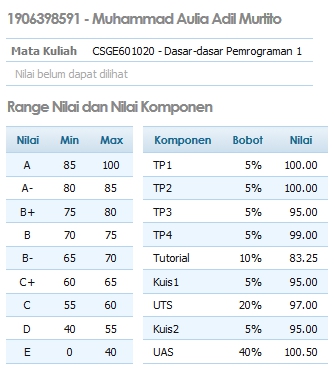
I hope this will be useful for you (SOFTCOPY ARCHIVE). As for the proof, here it is
Let’s move on to the theoretical course:
1. Discrete Mathematics 1 (3 credits)

What did I study in this course?
In this course, I learned:
- How to use logic rules
- How to analyze discrete structures
- How to prove mathematics statement
- How to count possibility out of a mathematics case.
*Look at the archive if you want to see the materials.
Why I categorize this course as theoretical?
Because you may use it if you want to do some computer science research. Kenneth H. Rosen said, “A key reason for the growth in the importance of discrete mathematics is that information is stored and manipulated by computing machines in a discrete fashion.” If you know some information about how to apply this course, please add it up in comment section.
How was this course system?
This course contained 3 credits which took 150 minutes for 2 classes. Back then, my Tuesday morning and Thursday noon were used for this course. If I count it right, you will have 6 absence quotas (3 months x 4 weeks x 2 days x 25%). The scoring system was like this.

In the class, the lecturer taught us the basics and made us do some exercises (fortunately, my lecturer loves exercises). Besides the class, there was a tutorial which made us have to solve problems for like 40 minutes and after we had done it, the assistant lecturer taught us the problems’ solutions. The tutorial wasn’t included for attendance reckoning and we had it for once in two weeks. As for the homework, it had to be done in folio paper.
The course only consisted of three exams and there was no quiz. The first exam’s material was about logic rules. The second exam’s materials were about discrete structure and induction. The last exam’s material was about counting possibility out of a mathematic case. As for the exam system, it was written as usual and the cheatsheet was already given.
NOTE: If you get caught cheating, you will get E for this course.

How did I deal with this course?
My foundation mindset to learn maths is “DO EXERCISES AS MANY AS POSSIBLE”. Maths course is all about problem-solving and the best way to overcome it is by getting used to it. Unless you want to be a scientist or mathematician, don’t do all the reading, JUST DO IT! I do the following steps to learn maths:
- Take a look at its formula
- Do its problem examples
- Try its exercises
- Take a look at its solution if I get stuck or to check the answer.
Here is a fun fact: the homework was harder than the exam. I always crosschecked my homework by asking an olympiad kid (thanks to Dewangga Putra Sheradien). Because I had understand the homework, I knew the big picture of the exam. As for the book, I used Discrete Mathematics and Its Applications (Seventh Edition) by Kenneth H. Rosen.

By Kenneth H. Rosen
This is how I dealt with each of the scoring components:
- Exam : Faced it by studying the previous exam. Invested like 2 days either for first, second, or last exam.
- Homework : Tried to solve it by myself and have a smart guy’s homework to make sure the answer.
- Tutorial : If I paid attention to the lecturer’s exercises, I don’t really have a hard time solving the answer. But if not, ask your friend to crosscheck your answer.
Testimony
Well actually, I don’t hate this course. I like the problems which made me have to think and analyze. In my opinion, this course didn’t have many long algorithmic problems yet if there was one, it was quite exciting to be solved. Overall, I give this course 8/10.
My most emotional moment for this course is after I did the final exam. I was so sure about my answers but when I crosschecked it with my friend’s answers, 2 out of 5 problems had the wrong answer. I felt so bad about that and blamed myself for not careful enough. My answers’ process was quite correct but its result was wrong.
But, Alhamdulillah, Allah Subhanahu wa Ta’ala decided differently from what I expected. Allah gave my exam to a “process-oriented evaluator”. I was very happy when I knew this and thought to myself, “Whatever I do, it is all already planned. Tawakkal (leave the result to Allah) is the key for a heart that always hesitate.”
Archive and Proof
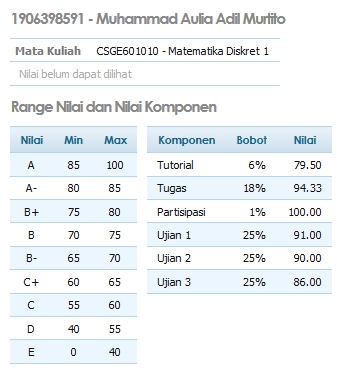
I hope this will be useful for you (SOFTCOPY ARCHIVE). As for the proof, here it is
2. Introduction to Digital System (4 credits)

What did I study in this course?
In this course, I learned:
- How to analyze binary number and its implementation in digital system.
- How to analyze logic circuit and sequential logic circuit.
- How to make logic circuit and sequential logic circuit with its simulator (Logisim).
- How to analyze a combinational circuit, registers, and memory in digital system(?)
NOTE: (4) The lecturers taught us but they didn’t include the topic in the exam. Only Binary Adder-Subtractor (BAS) subtopic that got included in midterm exam’s computational essay but I guess almost nobody could solve the problem.
Why I categorize this course as theoretical?
Because I think it might be used for quantum computer research. If you know more about implementing this course, please add it up in comment section.

source:
Kurzgesagt, “Quantum Computers Explained”
How was this course system?
NOTE: I took this class in odd term which might have a different system with even term.
This course contained 4 credits which took 200 minutes for 2 classes. Back then, my Monday and Wednesday noon were used for this course. If I count it right, you will have 6 absence quotas (3 months x 4 weeks x 2 days x 25%). The scoring system was like this.

Like always, the lecturer taught us the basics and gave us some exercises. Because some problems require a computer to be solved (making logic circuit), we had the class at the computer laboratory and of course we could bring our own laptop as well. There were quizzes and there were also tutorials but I don’t think the tutorial needs to be attended because the deadline is always at 11.55 pm. The tutorial was about making a logic circuit. As for the homework, it had to be done in folio paper.
We did the exam with the laboratory’s computer. We could open PowerPoint presentation and our own notes in the exam. The exam contained multiple choice for the first part and computational essay for the rest. The essay is all about making a logic circuit. The final exam material is from the first chapter until the latest chapter. Besides the exam, there was a final project which had heavyweight at the score but the final project was about making a sequential logic circuit in Logisim (this course illustration literally describes what IDS is).
NOTE: If you get caught cheating, you will get E for this course.
How did I deal with this course?
My foundation mindset to learn this course is “DO EXERCISES AS MANY AS POSSIBLE AND SOLVE IT UNTIL IT IS DONE”. The word “meticulous” really suits this course especially at making a logic circuit. When making a logic circuit, I think the analyzing part is only at the truth table. The rest is just long boring steps (computer should have done it instead of human) and that long boring steps require meticulousness which is why I did many exercises and tried to solve it until it is done. I did the following steps to learn IDS:
- Learn a chapter and skim its theory.
- Do its problem examples
- Try its exercises
- Take a look at its solution or simulate it if I want to check the answer
“FOLLOW YOUR HOMEWORK” is the advice that I could give. All problems (except BAS) in the exam were similar to those in the homework assignments. Prioritize homework -> PowerPoint’s exercises -> previous exam -> book’s exercises. As for the book, I used Digital Design (Fifth Edition) by M. Morris Mano and Michael D. Ciletti.

by M. Morris Mano and Michael D. Ciletti
This is how I dealt with each of the scoring components:
- Exam : Faced it by studying similar problems with the homework. Invested like 4 days for midterm exam and 2 days for final exam.
- Homework : Tried to solve it by myself and have a smart guy’s homework to make sure the answer.
- Tutorial : Tried to solve it by myself and crosschecked it with my friend’s answer.
- Quiz : Before midterm, the quizzes were sudden and after midterm, the lecturer told us when. If the lecturer told us, I studied the topic for 2-3 hours.
- Final Project : Tried to solve it by myself and crosschecked it with my friend’s answer.
Testimony
To be honest, I don’t like this course because it made me do long boring meticulous steps that a computer should have done instead. I think what I do here is what’s called “portering” (nguli). I give 6/10 for this course.

source:
lingkunganhidup8blog.wordpress.com
I guess the most memorable thing in this course is its culture. The situation was like this: we did the class in a computer lab and if things got boring, most of us used the lab’s computer to amuse ourselves like playing games, browsing the internet, or watching Youtube. Only when the lecturer gave us exercises that we paid attention.
Archive and Proof
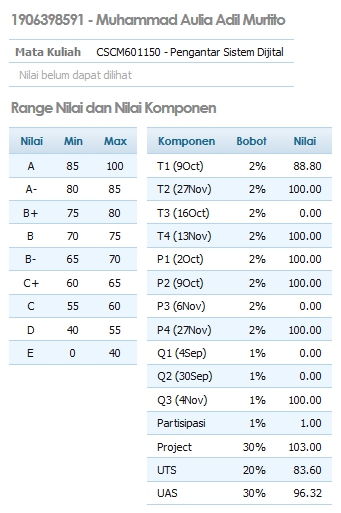
I hope this will be useful for you (SOFTCOPY ARCHIVE). As for the proof, here it is
3. Calculus 2 (3 credits)

What did I study in this course?
To make it simple, I learned:
- More advanced differential and integral
- Slice of conic and its coordinate
- Sophisticated series of number
*Look at the illustration if you want to know the complicated version.
Why I categorize this course as theoretical?
Well, I think the derivative parts will be useful for computer science research because it is utilized to optimize something. If you know more about implementing this course, please add it up in comment section.
How was this course system?
This course contained 3 credits which took 150 minutes for 2 classes. Back then, my Tuesday and Thursday morning were used for this course. If I count it right, you will have 6 absence quotas (3 months x 4 weeks x 2 days x 25%). The scoring system was like this.

Like always, the lecturer taught us the basics and gave us some exercises. It has 6 quizzes which felt very often to me. I could bring cheatsheet to either quiz or exam. The exam felt like another ordinary exams (computational essay). As for the homework, It had to be done in folio paper.
NOTE: If you get caught cheating, you will get E for this course.
How did I deal with this course?
My foundation mindset to learn maths is “DO EXERCISES AS MANY AS POSSIBLE”. Maths course is all about problem-solving and the best way to overcome it is by getting used to it. Unless you want to be a scientist or mathematician, don’t do all the reading, JUST DO IT! I do the following steps to learn maths:
- Take a look at its formula
- Do its problem examples
- Try its exercises
- Take a look at its solution if you get stuck or to check the answer.
This course’s textbook (Calculus 9th edition) was great. I really liked the exercises and most of its solutions. For me, this course’s PowerPoint was just a reference but still, I prioritized the exercises from this book.
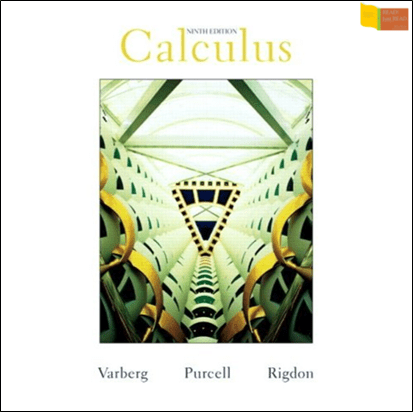
By Dale Varberg, Edwin Purcell and Steve Rigdon
This is how I dealt with each of the scoring components:
- Homework : Tried to solve it by myself and check the answer by opening the textbook’s student solutions.
- Active participation : As long as I can remember, everybody got a point even though they answered it wrong.
- Exam : Faced it by studying quizzes, homework, and previous exam. Invested like 1 days for midterm exam and 1,5 days for final exam.
- Quiz : Faced it by studying this kind of problems in the textbook (unless a story problems). Invested like 2 days for each quizzes.

Testimony
Well if the problem requires more analytics and less meticulous steps with long equations, I like it and the opposite if not. For example, I liked it when I had to make the integrals equation part at multiple integrals subject’s problems because I had to imagine the shape of it but when it came to the calculation, I didn’t really fond of it. So in the end, I give 7/10 for this course.

Analytics part (I love it)
Calculation part (I hate it)
The most memorable thing in this class is that I was in the same class with the best TOKIs (Informatics Olympiad Medalist) of CS batch 18. I don’t know if they are smart or diligent or both of it but they stood out in the class. Their scores were above averages and sometimes, their solutions were anti-mainstream. I guess if you want to be a humble person, you should be around them.
Archive and Proof
I hope this will be useful for you (SOFTCOPY ARCHIVE). As for the proof, here it is

EPILOG
I only had 4 courses while normal freshmen would have 6 courses (20 credits). The only thing that added up my busyness was my previous organization in electrical engineering which was EXERCISE Alpha. I had many spare times and I used it to learn robotics and programming. If I have to make a time comparison, it would be like this:
- Foundation Programming 1 : 40%
- Calculus 2 : 25%
- Introduction to Digital System : 15%
- Discrete Math 1 : 13%
- EXERCISE Alpha : 7%
If I have a sentence to describe this term, it would be “Alhamdulillah” (praise be to Allah). It is a real bless for me to be accepted in Computer Science UI. What’s certain is that it is all because of Allah Subhanahu wa Ta’ala, not because of me. I only ikhtiar (trying) but still, Allah decided.
And of course in the way of my ikhtiar, there always someone to help me. I want to say thanks to them:
- My family
- Ms. Meganingrum Arista and my Programming Foundation 1 classmates and labsis
- Ms. Arawinda Dinakaramani, Mr. Petrus Mursanto, and my Introduction to Digital System classmates and labsis
- Mrs. Dina Chahyati and my Discrete Mathematics 1 classmates and assistant lecturer
- Ms. Khumaisa Nur’aini and my Calculus 2 classmates
- Maung and Quanta Asrama
- Some of my Pacil friends
And to end this writing, If you ask me for habits advices, well, here it is:
- Don’t sleep late because you will be tired in the morning and could leave your obligation to sholat shubuh
- Use pen and correction tape instead of pencil when exam
- Prioritize your needs
- Do ANALOG REFRESHING(reading, walking, real-life talking) and don’t do DIGITAL REFRESHING(Instagram, Youtube, internet-related things)
- Study in silence
Okay that’s all for my review. I hope you guys enjoyed it. Thank you for the attention!
I would appreciate it if you want to discuss something with me such as asking questions, adding information, or even doubting my statements. Please understand that the reason why I made this article is to be friends with you. Boleh banget kok pake Bahasa Indonesia apalagi speak English hehehe.
 Muhammad Aulia Adil
Mantap dil. Kalo gua matdis 1 sih kuncinya baca bukunya si K.H. (Kenneth H. bukan Kiai Haji) Rosen. Nanti di term 2 bahkan matdis 2 gak perlu repot-repot makan waktu baca bukunya Rosen, dari PPT dosen aja menurut gua dah cukup bgt kok.
SukaSuka
Halo papskipapapa, terimakasih atas tipsnya.
Dari pengalaman gw kemaren di MD 1, ada dosen yang pptnya ngikutin persis dari bukunya bahkan beberapa soal di PR juga diambil dari bukut tersebut.
SukaSuka
Beberapa blog yang juga mereview semesteran mereka
https://www.jurnalgalang.com/
https://fairuzi10.com/
SukaSuka
masyaa allah barakallah fik dil
BTW ini kan konteksnya semester 1 ya, yg mana kebanyakan maba (yg bukan pindahan) cuma ngambil md1 sama ddp1 yang beririsan sama yg lu ambil dil. Gua jg ada tips nih wakakakak buat ddp1, dmn meskipun adil kategoriinnya practical, tapi uasnya in essence gua rasa theoretical banget.
Approach belajar (kuis, uts, dan uas) yang gua ambil buat ddp1 selain pahamin fungsi dan implementasi dari masing-masing kodingan, gua juga manfaatin cheat notes yg boleh dibawa pas ujian, yang mana gaada batasnya asalkan tulis tangan. Dan karena cheat notesnya boleh berupa catatan, gua bawa binder gua, yg isinya setiap dosen ngasih penekanan tentang suatu materi di kelas, pasti gua catet. Dan voila! yang gua catet keluar jadi soal semua pas UAS, alhasil nilai DDP gua tertolong 🙂
SukaSuka
Wa fiik barakallah Fahdi, iya Alhamdulillah nih hehe
Kalo gw dulu make cheatsheetnya itu buat yang bener-bener dihapal kayak “format.(…)” atau exception. Yang lainnya kalo gw sendiri emg harus sering-sering latihan supaya jago memprediksi tiap-tiap outputnya
SukaSuka
Halo, saya Ibnu, Teknik Informatika, Undip 2018, mau share pengalaman semester I saya selama di IF, kalo disini, nama matkulnya itu Dasar Pemrograman, yang biasanya disebut Daspro.. Bahasa pemrograman yang digunakan waktu itu python, saya yang baru belajar bahasa pemrograman sejak masuk perkuliahan (mulai dari 0), terlebih dahulu diajarkan apa itu algoritma, bagaimana membuat algoritma yang baik dan benar sesuai aturan, sehingga dapat menjadi solusi suatu permasalahan. Waktu belajar tatap muka dengan dosen di kelas, kami diajarkan membuat notasi algoritmik yang ditulis tangan, dan bahasa python diajarkan pada saat praktikum, metode praktikum nya, diberikan persoalan-persoalan sederhana yang berpatokan pada buku diktat yang disusun oleh ibu Inggriani Liem, dan masih banyak lagi yang bisa diceritakan, tapi takut kepanjangan, jadi segitu dulu aja ya.. ~~ hehe
Sukses terus, adminnya..!!
SukaSuka
Halo Ibnu, salam kenal wkwkwk, makasih ya atas ilmunya dan semoga lu juga sukses nu di sana heheh
SukaSuka
You write very well, bro! I enjoyed reading your writing 😁
There is this one thing that’s interesting enough for me. Our lab work is different from yours. Here in STEI / IF ITB, we are not allowed to either ask the lab assistant or work together with our friend to solve our programming problems. If you get stuck at it, you just have to wait until the time runs out :’)
I think that’s all from me.
Sukses terus Adil ~
SukaSuka
Hi Indra thx for the compliment and insight heheh. May i know the programming language that you used? is it C++, Java, or Python?
Lu juga semoga sukses ndraaa
SukaSuka
Congratulations Adil!
Your blog post is already good, this blog post will surely be useful for those who want to study Computer Science at Universitas Indonesia.
Maybe I can add some tips to get good grades in both IDS /PSD (Introduction to Digital System) and Foundations of Programming (DDP).
For DDP, make sure that you always submit all the programming assignments (TP) and lab exercises. Because the weight for Programming Assignments will be the same as the midterm exam. Make sure that you put comments in your code because 10% of your assignment score is based on your code documentation. Last semester, I was a teaching assistant for this course and in my experience, grading well-documented code is easier because I can easily understand your idea to solve the given problem. In the demo session, make sure that you can explain your code well because 30% of your score is based on your explanation in the demo session. For exams, make sure that you are well prepared to answer some tricky questions, most of the time it is related to “Mutable and Immutable”.
For IDS, make sure that you always do your homework because it helps you to review some materials. Paying attention to the materials is also important because there are a lot of important materials in one lecture session and those materials/topics will be used for other topics. Let us take “Minterm and Maxterm” as an example. If you don’t understand minterm and maxterm, you won’t be able to understand Karnaugh map (K-Map). If you don’t understand K-Map, then you won’t be able to do 5 step design to make a combinational circuit. If you can’t design a combinational circuit, then you won’t be able to design a sequential circuit. So make sure that you understand every topic in the IDS course by paying attention to the presented materials in the lecture session.
SukaSuka
Thank you for the compliment 😁
Programming task demonstration is a simulation for real-life work of a programmer. In order to collaborate with other programmers, we need to be good at explaining our code. The documentation is one way of doing that and of course also the face-to-face method. As for the “immutable and mutable”, it really got me back then 😂
Homework is really important. I suggest everyone who wants to take this course to do his own homework. Only when they want to crosscheck the answers that they cooperate 😁
SukaSuka
Sepengalaman gw belajar di pacil memang harus banyak latihan terutama di bidang matematika dan programming. Seperti pepatah legendaris Bruce Lee “ I fear not the man who has practiced 10,000 kicks once, but I fear the man who has practices one kick 10,000 times.” Salam Sukses, Adil.
SukaDisukai oleh 1 orang
Wow what a good quote!
Makasih banyak Steven, semoga lu juga sukses dagangnya. Sampe ketemu lagi di POK 😂
SukaSuka